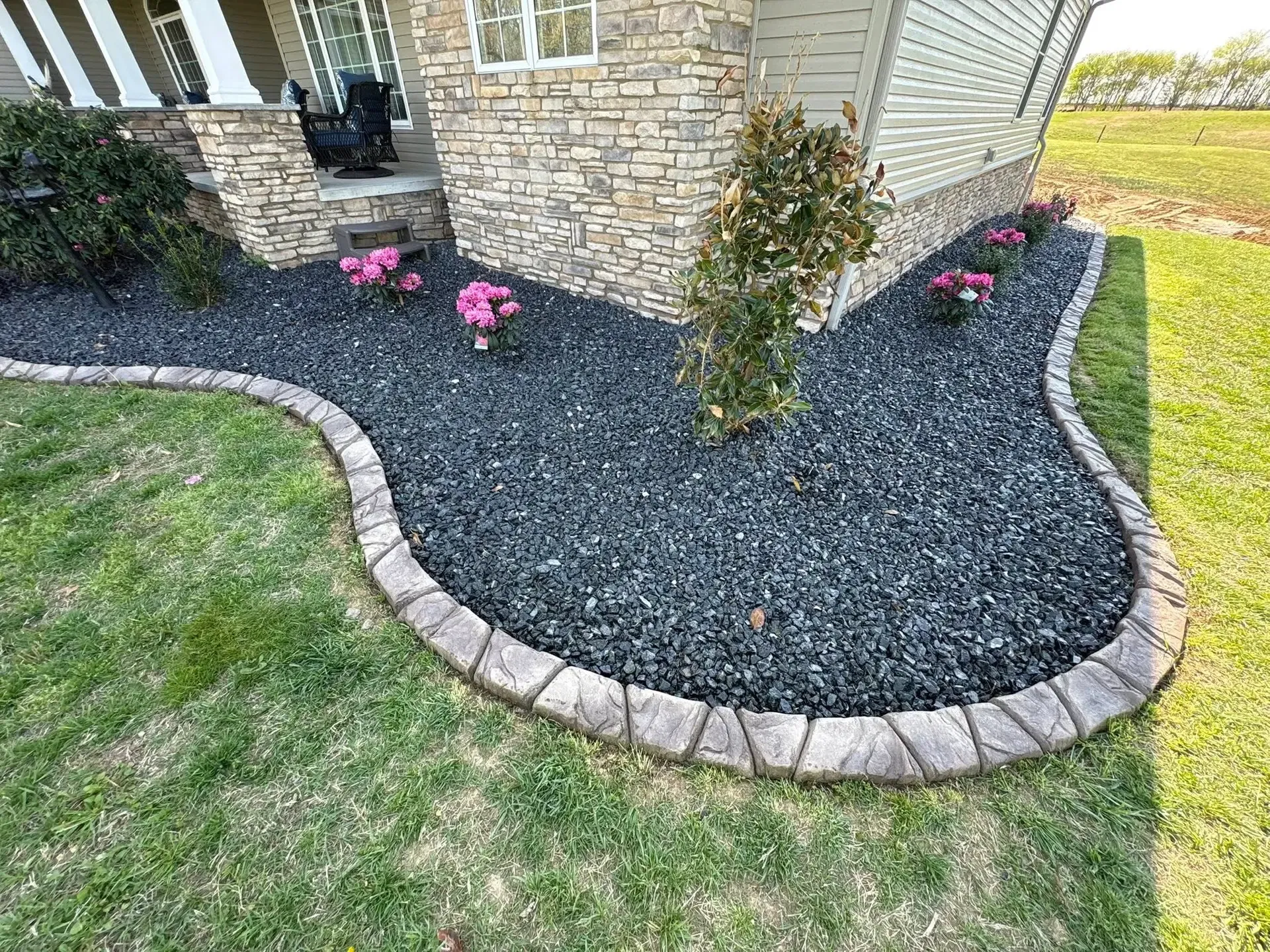
A completed curbing installation shows how a clean, continuous edge can bring a landscape bed into sharper focus.
If you are budgeting for professionally installed concrete curbing in Western Kentucky, Southern Illinois, or Northern Tennessee, plan on about $24–$38 per linear foot for premium, fiber-reinforced, hand-finished curbing in 2026. Custom colors, intricate designs, challenging access, or extra site work can push a project higher.
For a straightforward 100-foot installation, that is roughly $2,400–$3,800. Use this as a planning range, not a site-specific quote. Your final number depends on the footage, ground conditions, design choices, and whether grading or drainage needs attention first.
A much cheaper quote often describes a different product: thinner curbing, less preparation, fewer finish details, or some combination of the three. A low number is not a bargain if the border cracks, shifts, or needs replacing.
At The Muscle, we measure the work and explain the scope before installation. The quote is the number, no hidden add-ons.
/ Dept 01: What the Price Covers
Pay for a finished edge built for your property, not just concrete by the foot.
Decorative concrete curbing is extruded on site as a continuous landscape border, then shaped and finished by hand. A complete installation may include layout, sod and root removal, trench preparation, concrete and fiber reinforcement, stamping, coloring, sealing, and cleanup.
The finished edge can define planting beds, help keep mulch or decorative stone in place, and create a crisp transition between lawn and landscape. The right profile can also make mowing along a bed easier and reduce the need for string trimming.
The full installation matters. In Western Kentucky, wet clay soils, heavy rain, and freeze/thaw cycles can put pressure on poorly prepared work. A tidy curb placed on top of loose sod is not the same job as one set into a properly prepared channel.

This finished stamped border traces a curved landscape bed and separates the planting area from the lawn.
/ Dept 02: What Moves the Number
Footage sets the baseline. The site and finish determine the rest.
- Total linear footage: Longer runs often spread mobilization and setup across more footage. Short or broken-up runs can cost more per foot because layout and setup still take time.
- Ground preparation and grade: Uneven grades, soft spots, dense clay, and elevation changes may require more shaping and preparation.
- Sod, roots, and existing borders: Removing grass, established roots, old edging, or other obstructions takes additional labor. Tell the estimator what is already there.
- Profile and stamp: A simple slant profile is a different finish from a wood-grain or slate-style stamp. Some patterns and profiles take more care to form consistently.
- Color and antiquing: Standard color options differ from custom colors or multi-tone antiquing, which adds detail to the finished appearance.
- Curves and tight radii: Gentle curves are part of good landscape design. Tight turns and detailed shapes require careful layout and hand-finishing.
- Sealer: Ask whether sealer is included, what product or finish is proposed, and what maintenance it requires.
- Access and site conditions: Narrow access, obstacles, long material routes, and difficult staging can affect the work.
- Dirt work and drainage: If water is pooling or grade is directing runoff the wrong way, correct that first. A curb should not be used to trap water against a foundation or inside a bed.
For a closer look at pattern, color, and finish options, see decorative concrete curbing styles, colors, and patterns. You can also review The Muscle’s concrete curbing service to see how the installation is laid out, prepared, extruded, and finished.
/ Dept 03: How Concrete Compares With Other Borders
The right choice depends on how long you want the border to work, and what you want it to do.
| Border option | Rough 2026 per-foot reality | Trade-off |
|---|---|---|
| Plastic or poly edging | About $1–$4 per foot for DIY material; roughly $4–$12 installed | Low upfront cost and easy to shape, but thinner products can lift, crack, or loosen and may need resetting or replacement. |
| Standard steel edging | About $2–$8 per foot for DIY material; roughly $8–$18 installed | Creates a crisp line and can last longer than plastic, but costs more than basic poly and still depends on suitable installation and conditions. |
| Timber border | About $1.50–$7 per foot for DIY material; roughly $6–$14 installed | A natural look, but soil contact and moisture can lead to rot, movement, or eventual replacement. |
| DIY brick, stone, or block border | Material cost varies substantially by product and whether you can reuse materials | The purchase price is only part of the job: base preparation, leveling, cutting, hauling, and resetting take time and tools. |
| Premium concrete curbing | About $24–$38 per foot installed | Higher initial investment for a continuous, custom-finished border, with cost affected by design and site preparation. |
These are broad consumer budgeting ranges, not local bids; material quality, installation scope, and site conditions vary. Published comparisons for landscape edging materials and costs and concrete, steel, and plastic edging provide additional background.
Concrete is not automatically the right answer for every bed. Plastic may make sense for a small, temporary planting area. Steel can suit a clean, understated edge. Timber may fit a rustic design if you are comfortable maintaining or replacing it. Concrete is worth considering when you want a defined, decorative border that can also make edging and bed maintenance more manageable.
For a fuller look at why homeowners move from temporary edging to concrete, read our related guide to concrete curbing quality and plastic edging.
/ Dept 04: The Maintenance Math
Count the time and materials you are already spending to maintain tired borders.
A clean mower-friendly edge can reduce string trimming along the beds. It may also help keep mulch and decorative stone from migrating into the lawn during heavy rain. That can mean less edging work, less raking, and fewer mower or trimmer bumps against a loose border.
Here is a simple way to estimate your own time savings: minutes spent trimming each visit × visits per year ÷ 60 = annual hours spent trimming. For example, if trimming a particular border takes 10 minutes and you do it 25 times a year, that is just over four hours annually. Your actual time will depend on the length and shape of the beds and how you maintain them.
Concrete curbing can improve curb appeal by making the landscape look more deliberate and finished. That can help a property make a stronger first impression, but no contractor can promise a specific resale increase. And while a well-built curb is intended to last longer than many temporary borders, no responsible installer should promise a fixed lifespan without accounting for installation, water, ground movement, and maintenance.
Sealer also needs attention over time. Ask how to care for the chosen finish and when resealing may be appropriate.

A separate completed installation pairs a curved bed line with decorative stone and planting.
/ Dept 05: Check the Installation Before You Sign
Ask direct questions. A professional should answer them plainly.
- What is in the mix? Ask whether the concrete is fiber-reinforced and what reinforcement is specified. Fiber helps control cracking; it does not make concrete immune to cracks.
- How will you prepare the ground? The crew should explain sod and root removal, trench preparation, and how the curb will be set at the planned elevation.
- How will you handle water? A continuous edge can affect runoff. Ask how the design avoids holding water against your home or creating a low spot in a bed.
- What about freeze/thaw and sealer? Ask how the selected mix, finish, curing, and sealer are suited to outdoor exposure, and what maintenance is expected.
- What does the workmanship warranty cover? Get the terms in writing. Ask what is covered, for how long, and what conditions are excluded.
Also ask who will be present, whether the contractor carries insurance, and how the work is checked before the crew leaves. A written proposal should identify the footage, profile, stamp, color, preparation, sealer, cleanup, and any dirt work or drainage correction. That is how you compare complete scopes instead of vague totals.
The Muscle’s team is insured and professionally trained, and we stay involved in the work. The Muscle is also a Unilock Authorized Contractor for applicable hardscape work. That credential relates to our hardscape installations; it is not a claim that Unilock certifies concrete curbing.
/ Dept 06: Local Conditions Matter
Your landscape edge has to work with the ground around it.
In Paducah, Mayfield, Murray, Benton, and Calvert City, the same curb design can require different preparation from one property to another. Western Kentucky clay can hold water. Heavy rain can expose drainage problems. Freeze/thaw cycles can move wet ground. A border that interrupts the natural flow of water may create a new problem instead of solving one.
On properties near Kentucky Lake and Lake Barkley, slopes, access, runoff, and shoreline conditions deserve a closer look. Requirements vary by property and location, so ask what needs to be checked before work begins.
When curbing is part of a larger outdoor project, consider the full layout, including planting beds, drainage, patios, and grade changes. Our Western Kentucky outdoor living cost guide covers how those elements can fit together.
The Muscle serves homeowners and property owners across Western Kentucky, Southern Illinois, and Northwest and Middle Tennessee.
/ Next Step: Request a Bid
Get a site-specific number without the sales pitch.
If you are searching for concrete curbing near me, concrete curbing cost, or landscape curbing prices, start with a conversation about your property. We will review the layout, discuss the finish you want, and put a real number on the work. No pressure and no hidden add-ons.
Request a Bid from The Muscle: the primary next step. You can also download the Contractor Packet for more about our company and process, or call (270) 248-9790.
13-Item SEO Package
- Article title: How Much Does Concrete Curbing Cost in Western Kentucky? 2026 Per-Foot Pricing Guide
- SEO title: Concrete Curbing Cost in Western Kentucky: 2026 Pricing
- Suggested URL slug:
how-much-does-concrete-curbing-cost-western-kentucky-2026 - Focus keyphrase: concrete curbing cost Western Kentucky
- Secondary keyphrases: concrete curbing near me; concrete curbing cost per linear foot; landscape curbing prices; concrete landscape edging cost; concrete curbing Paducah KY
- Meta description: See 2026 concrete curbing cost ranges for Western Kentucky, Southern Illinois, and Northern Tennessee, plus price factors, edging comparisons, and what to ask before hiring.
- Excerpt: Budget about $24–$38 per linear foot for premium concrete curbing in 2026. Learn what affects the price, how it compares with other borders, and what a sound installation includes.
- Search intent: Local, high-purchase-intent cost research and contractor consideration.
- Target locations: Paducah, Mayfield, Murray, Benton, Calvert City, Kentucky Lake, Lake Barkley, Southern Illinois, Northwest Tennessee, and Middle Tennessee.
- Internal links: Concrete curbing service page; curbing quality and plastic edging guide; decorative curbing styles, colors, and patterns; outdoor living cost guide; Contractor Packet.
- Hero image alt text: Finished decorative concrete curbing outlining a dark landscape-rock bed beside a home.
- Social title: What Does Concrete Curbing Cost in Western Kentucky in 2026?
- Primary conversion action: Request a Bid; secondary options are the Contractor Packet download and phone call at (270) 248-9790.
Leave a Reply